Physical activity is very important. That is why physical games should be played at home, but also at the kindergarten. During team-based games, children integrate, develop creativity, become relaxed and gain many useful skills. You will find many interesting physical games for both small and large groups of participants. Such activities should take place at least once every day. Feel free to use our list of group games and choose the most interesting ones
physical games for children
The most interesting physical games and activities to be played at kindergarten
The carnival starts soon and it means that it will be necessary to come up with unique attractions for kids. Check our list of the most interesting
You should also check out our most interesting physical outdoor games and activities on our channel, we strongly encourage you to do so
GAMIONARY CHANNEL ON YT
Which physical games for the youngest are the best?
The choice of the game depends on the amount of free space and the size of the group. In order to choose the proper game, we divided our list into several categories. First, we will describe games and activities that can be played in small rooms (that are probably at your disposal at the kindergarten). Another category is for outdoor games – we assume that your kindergarten has a backyard or a place where you organize games during warmer seasons. Of course, we encourage you to find games on your own. All you need to do is to go to our
Book of Games and choose instructions you are interested in.
Games and activities to be played in a small room at kindergarten
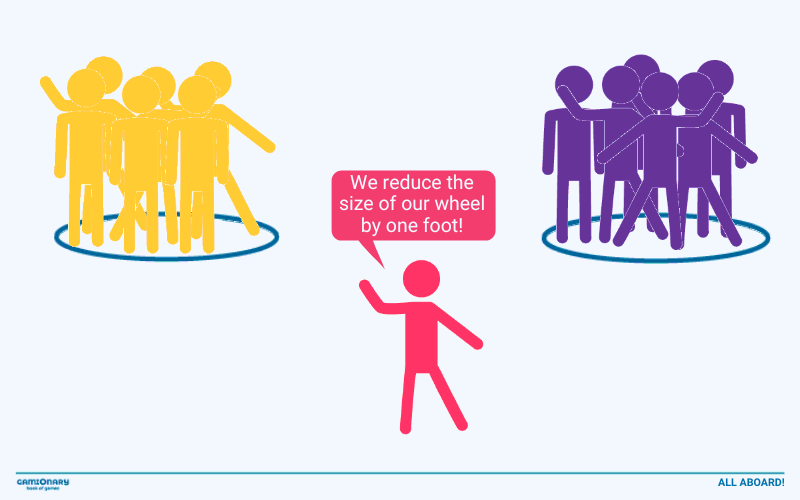
All aboard!
 Preparation
- Divide players into groups of 6 or 8 people.
- Ask each group to use a skipping rope to create a circle on the ground (it will be their lifeboat).
Game rules
- Each team stands inside their lifeboat.
- In the next round, players make their circle smaller by one foot (about 30cm).
- Players again enter their lifeboat. All players must fit into the circle. They must not touch the edges (of the skipping rope).
- Each round, players keep making their lifeboat smaller.
- The team that does not manage to fit into their lifeboat loses.
Goal
See the full description + modifications: All aboard!
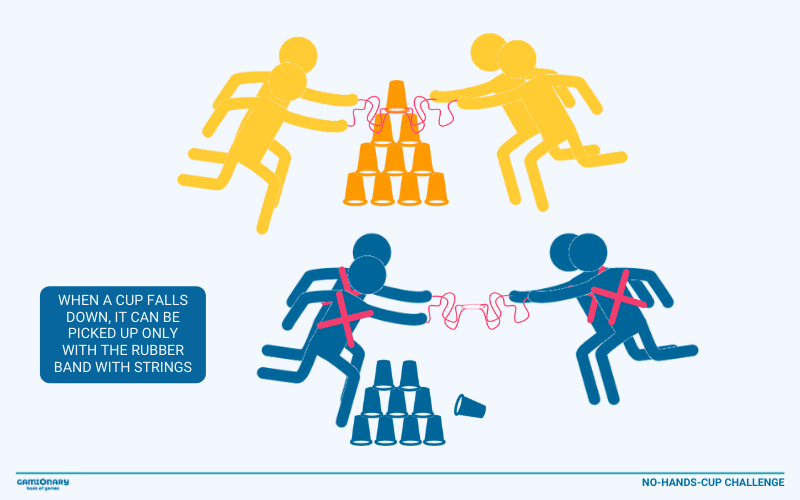
No-hands-cup challenge
 Preparation
- Divide participants into teams.
- Prepare a small rubber band for each team. Tie as many strings to the rubber band as there are players in the team.
- Prepare 10 cups per team.
Game rules
- Each person from the group holds onto one string tied to the band. As a group, they must use the band to raise the cups and stack them to form a pyramid.
- When a cup falls down, it can be picked up only with the rubber band with strings.
- The game lasts until the task is fully completed, e.g. a pyramid of 10 cups is built.
Goal
See the full description + modifications: No-hands-cup challenge
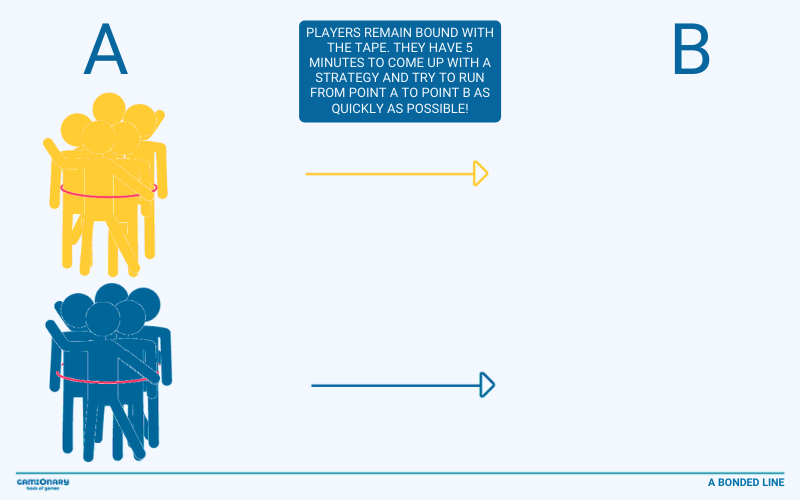
A bonded line
 Preparation
- Divide players into teams of 5-6 people and bind them together with tape.
Game rules
- The goal of the game is to go from point A to point B.
- Players get 5 minutes to come up with a strategy.
- On signal, players start running towards the finish with their time measured.
- When every team has been told their time, they can come up with a new strategy.
- After two attempts of each team, choose the winner with the best time.
Goal
- To move as fast as possible
See the full description + modifications: A bonded line
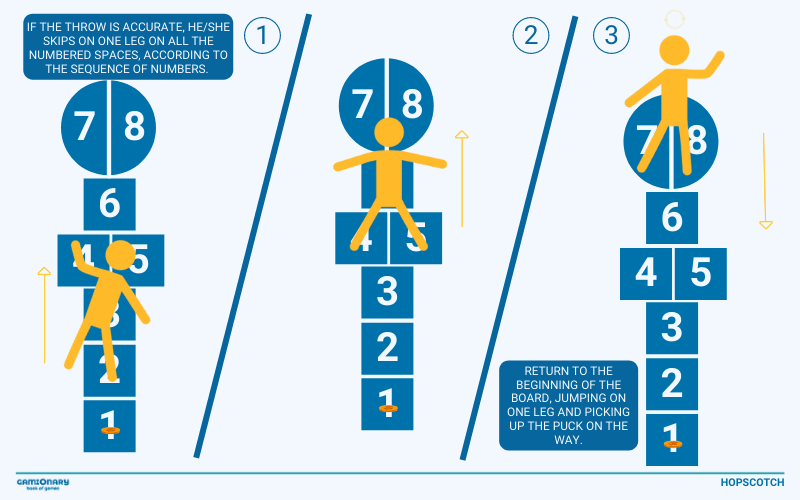
Hopscotch is one of the most popular games for the youngest children. Nowadays, all you need to do is to buy a mat dedicated for this game or draw the needed fields and assign them with numbers from one to five. The rules of this physical game are very simple – the child tosses e.g., a gym sack and must jump on the drawn “fields” until he or she reaches the tossed object. The person who does not fall or confuse the order scores a point.
Find the game here:
At kindergarten, we recommend playing the following game: “Figures, rows, patterns”. This physical game is about recreating patterns that must be memorized. First, arrange any pattern and then the child has several minutes to memorize the image and then he or she must turn around. Meanwhile, another participant shuffles the elements at random. Once they finished, the first player turns around again and tries to recreate the pattern. The game is good for children at ages from 4 to 7.
Other similar games:
- Say 5 – The selected person has several seconds to say names of 5 things/5 words connected with a previously selected category e.g. nature. find the game here:
- What’s missing? – Create an exposition consisting of various items. The selected participant tries to memorize the exposition and then turns around while the group chooses one item and takes it away. When everything is ready, the selected player turns around again and tries to guess which of the items is missing. find the game here:
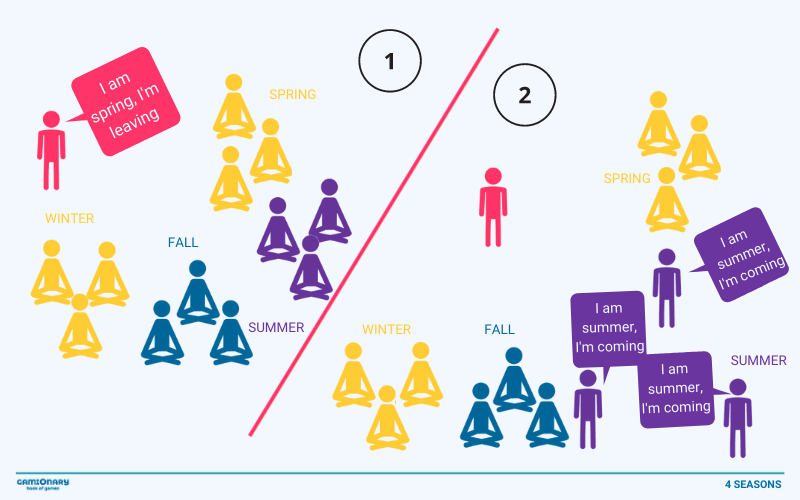
An interesting proposition for preschoolers is a group-based game titles
“4 seasons”. The goal of the game is to get the highest score. The game is for 6 to 60 people. First, divide the group into teams and choose a leader who will keep the score. Teams must stand according to the order of the seasons of the year. In this game, the rules are very simple as well:
– the leader starts the game by saying e.g., “I am summer and I’m leaving”,
– players who are “summer” stand up and say “I am fall and I’m coming”,
– if all the people do this task correctly, they score a point,
– the leader can say the names of seasons at random as well as change the word “coming” to “leaving”.
– You can add a different action that players must perform apart from standing up
 find the game here:
It must be mentioned that recently there have been many games created for preschoolers, but one should try to move back in time and think of “their” physical games. Let the new generation learn about the traditional games.
Traditional games and activities for children
Skipping rope should definitely be included on the list of traditional games. You can use this item to create various “competitions”: whoever skips more times, whoever will keep skipping for the longest time. Another example of a great game of this type was “Red Light, Green Light” (
Find the game here). In this game, children would stand next to each other at the end of a predetermined line. On the other side, there would be a person playing as “it”. When “it” covered their eyes, the group would move towards them. When “it” said “red light”, he or she would open their eyes and check whether everybody is standing still. If someone failed to do so, he or she would have to replace “it” or get a minus point or eliminated from the game.
Other games that are worth mentioning are: colors, balloon, tag, hide and seek, games with a beach ball, dodge ball. One would probably manage to think of many other games from the past that should be shown to the kids, but it is hard to remember them all.
You will find the list and descriptions of traditional games and activities here:
- Hide and seek – Find the game here
- Standard tag – find the game here
- Bottle caps game – find the game here
Advantages of physical games at kindergarten
Coming back to what me mentioned at the beginning… when children play together, they build strong friendships, learn various behaviors from each other, feel no restraints and are not overburdened with duties. Childhood games play a significant role in the development of one’s personality. Team games “bring” joy. Young people use them to relieve stress. Of course, education is important but it can also have many various forms. During physical games, one may eventually learn math or foreign languages. Edutainment is effective and you can find many interesting pieces of information covering this topic.
Where can you find interesting team games for children?
You will find more interesting games in our browser
www.Gamionary.com. Just enter the instructions that you are interested in and you will find many various games and activities. Every game has been described in detail.