Longer breaks such as winter holiday, Christmas or summer vacations often disrupt our contact with the class as a group and we must once again remind students about how fun it is to work together or make the work in class more dynamic. However, team-building games also help in dealing with situations that require planning or problem solving. Such skills are sometimes difficult and, what is more, give rise to many problems among the contemporary youth. How can someone easily learn how to work at school? We present several examples of team-building games
THE MOST INTERESTING FUNNY GAMES AND ACTIVITIES FOR ADOLESCENTS
When looking for the most interesting games, start your search with our YouTube channel! There, you will find maaaany games and activities. For this occasion, we have prepared a video on the most interesting games that need no equipment. We also encourage you to check out our YouTube channel where you will be able to find something that suits your needs.
Games without equipment
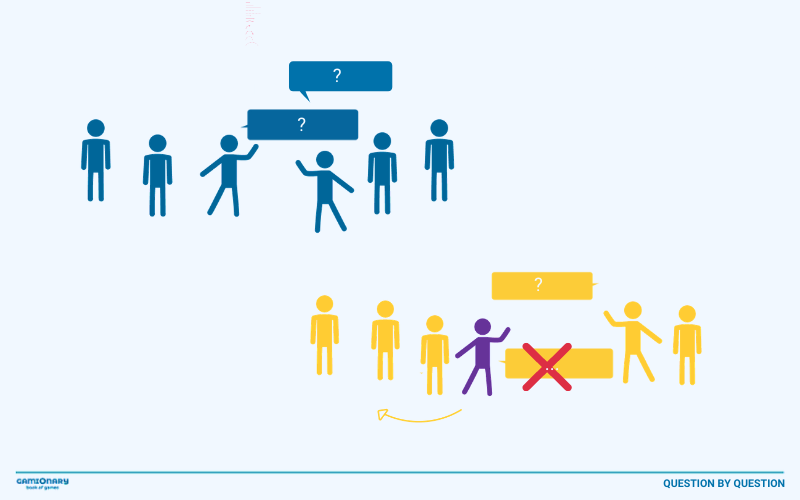
Question vs. question
Rules:
Two teams stand in rows.
Decide on the setting e.g., a queue at a butcher’s shop.
The two first participants from the team talk to each other by only using questions.
If one of them does not reply with a question or hesitates for too long, he/she goes to the end of the line.
The team whose first player once again moves to their original position loses the game.
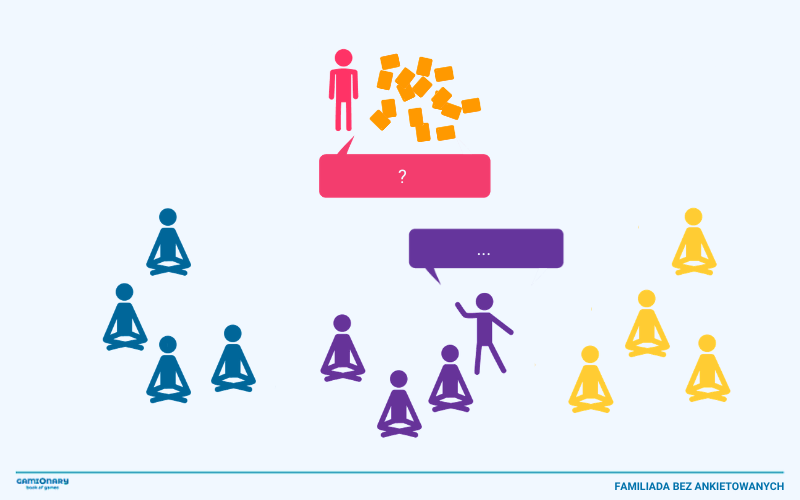
Before the game, prepare unusual open questions in form of sentences e.g. what is the most inappropriate thing to say to a cashier or what a broker and a cleaning lady have in common, etc.
The task of the participants is to reply to the question or finish the given sentence. Points are given to the best reply.
One of the simplest games and activities without equipment and without preparation. Good in small odd groups.
Rules:
Participants sit in a circle. It would be good to have an odd number of people in the game.
At the signal, all participants must clearly look at any other player.
If your eyes meet, both people are out.
If a player looked at someone who did not look at him, play continues.
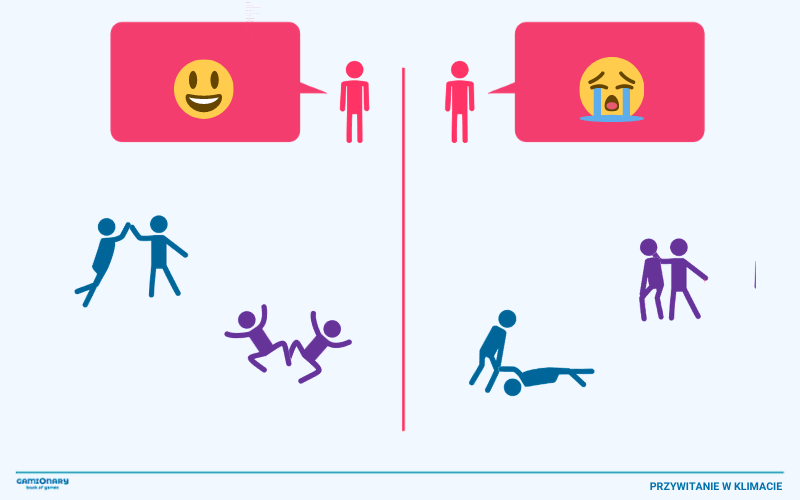
An atmospheric greeting
Rules:
In pairs, each participant has to greet the other. However, the greeting must reflect the emotion or situation selected by the game leader, for instance: “you have not seen each other for years” or “you must reflect sadness”, or “you must act as cartoon characters”.
The goal of the game is to do something opposite to the order given or shown by the game leader, e.g. when the game leader says “go”, participants must stand still, etc.
The person who fails to do the opposite thing is out of the tame.
The last player wins.
The game can be played for points or just for fun and the laughs.
FUNNY TEAM-BUILDING PEN AND PAPER GAMES FOR ADOLESCENTS
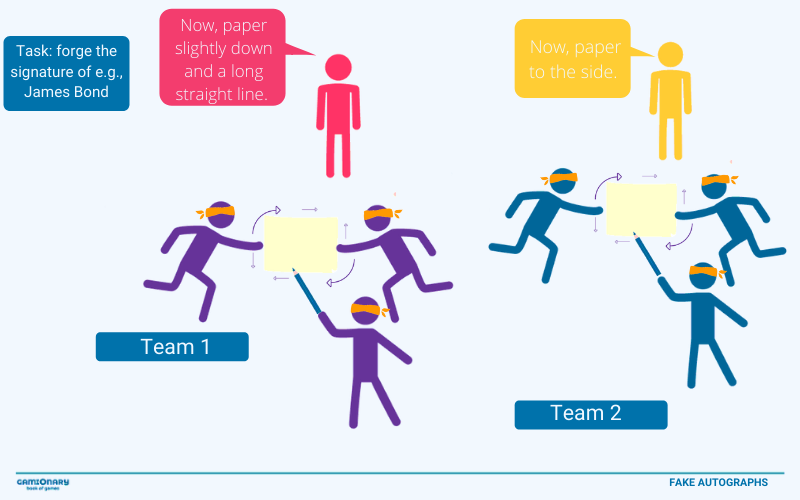
Fake autographs
Rules:
In each group of 4 people, 3 people are blindfolded.
Two people hold a large piece of paper while one person is holding a marker pen. The person with the marker pen must not move.
The only person in the team who can see tries to guide the people with the piece of paper in such a way that the person with the marker pen will write their or someone else’s (e.g. James Bond’s) legible signature.
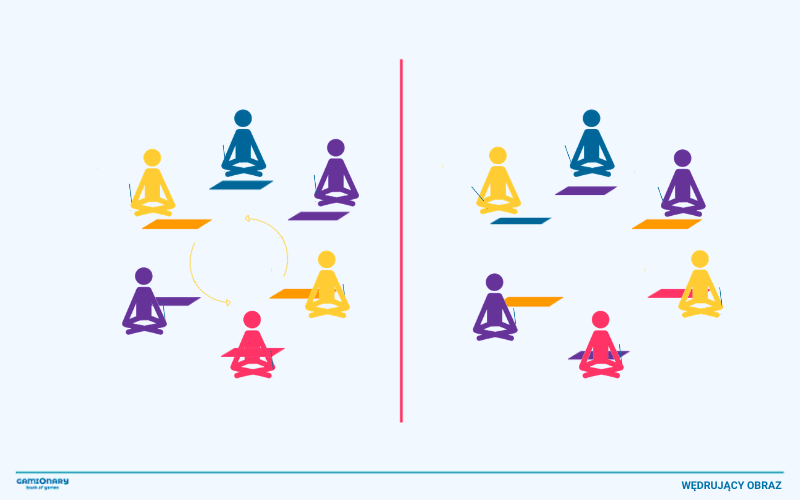
On signal, each participant tries to create a drawing with any composition. It can be an object, a phenomenon, or a situation (participants have complete freedom).
On another signal, everybody passes their piece of paper to the right. Participants continue drawing on their new pieces of paper, in a way they find fitting. They should stick to their original plan in order to make the work of art more interesting.
The game ends when the drawings are ready and the piece of paper do a full circle. Each participant may check how their drawing changed and whether it matches their intended composition.
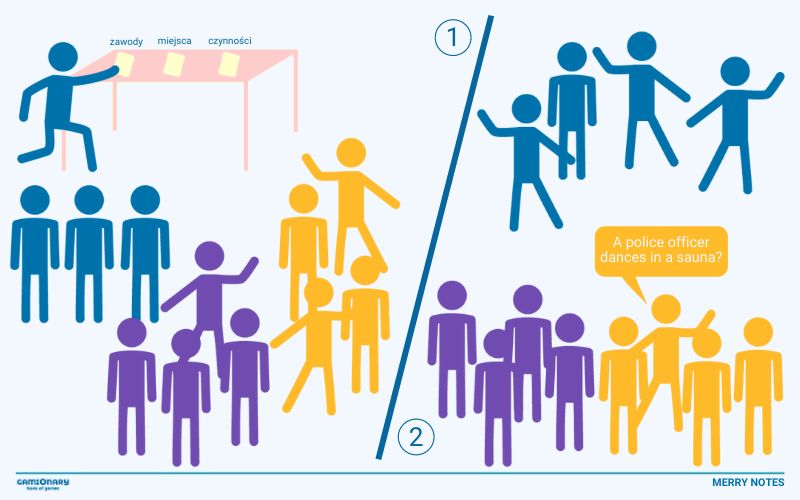
Prepare three piles of papers. Each pile will consist of pieces of paper with text on a specific subject: names of professions, places or activities.
Divide participants into teams.
Each team draws one piece of paper from each pile. They use the words to form a sentence e.g., “A police officer dances in a sauna”.
The team has some time to prepare a performance depicting their sentence without using any words.
Other teams try to guess the whole sentence that has been shown.
FIND THE GAME HEREFrequently asked questions:What equipment do you need for the games?
In our article, you will find examples of games that need some equipment (skipping ropes, cups, etc.) but also propositions that can be played without any props – word games. Apart from that, we encourage you to use our browser – there, you will find all the possible combinations and games perfect for your needs!
What is the preferred age of adolescents?
If we assume that the age of adolescents is between 11 and 20, we have a pretty wide range to cover. An 11-year-old boy will be interested in different things than a 19-year-old young man. We have tried to pick games and activities that will be universal and work out perfectly for every group of adolescents that you will work with.
You will find more interesting team-building games on our YouTube channel:Team-building games.If you need more precise propositions, use our browser.
Table of contents
The Power of Games and Physical Activities
The book "The Power of Games and Physical Activities" shows how to use games and activities for student development – not just physical, but also emotional, social and cognitive. It is a practical and inspiring guide for PE teachers, coaches and facilitators, full of scientific research, examples and ready-made ideas.
To provide the best experiences, we use technologies like cookies to store and/or access device information. Consenting to these technologies will allow us to process data such as browsing behavior or unique IDs on this site. Not consenting or withdrawing consent, may adversely affect certain features and functions.
Functional
Always active
The technical storage or access is strictly necessary for the legitimate purpose of enabling the use of a specific service explicitly requested by the subscriber or user, or for the sole purpose of carrying out the transmission of a communication over an electronic communications network.
Preferences
The technical storage or access is necessary for the legitimate purpose of storing preferences that are not requested by the subscriber or user.
Statistics
The technical storage or access that is used exclusively for statistical purposes.The technical storage or access that is used exclusively for anonymous statistical purposes. Without a subpoena, voluntary compliance on the part of your Internet Service Provider, or additional records from a third party, information stored or retrieved for this purpose alone cannot usually be used to identify you.
Marketing
The technical storage or access is required to create user profiles to send advertising, or to track the user on a website or across several websites for similar marketing purposes.




 Rules:
 Rules:
 Rules:
 Rules:
 Rules:
 Rules:
 Rules: