Ideas for Non-Competitive Teambuilding Games – Yes, It’s Possible, and Yes, Participants Can Get Really Engaged
Games and activities take on even greater importance in shaping the minds of our children and youth, especially in today’s world.
Why? Because some of the most important skills of the 21st century have been identified as problem-solving, creativity, and collaboration.
Most interactions in this world still occur between people, and one of the fundamental functions of play is to build a prosocial brain. Statistically, most games or activities involve completing a certain goal, and often achieving that goal requires finding the best possible solution. By imagining nearly any game or activity — especially a game — it becomes apparent that they support the development of skills such as problem-solving, creativity, and collaboration (though not always all at once).
Take the simple game of hide-and-seek as an example. There is a problem: you need to hide, while the seeker has the problem of finding participants before they reach the safe zone. Both sides must creatively solve this problem. The better you hide, the higher your chance of success. Similarly, the seeker, by devising an effective search strategy, increases their chances of catching more participants. Collaboration? It may not be prominent here, but if you organize hide-and-seek as a team game, all three skills are engaged
TEAM-BUILDING GAMES WHERE EVERYONE IS ON THE SAME SIDE
I understand that opinions vary about games with winners and losers. While many studies show the benefits of experiencing victory and defeat even at a school-age level, this article offers ideas for team games without competing against another team.
How can it still be called a game if there are no winners? By definition, a game involves a structured activity with specific rules, in which one or more people participate. Just as someone plays Tetris on their phone, these activities can also be considered as a game. You don’t need winners or losers to play You simply establish a set of rules and a goal. For example, the task could be to achieve the best possible time completing a mission as a team or to complete a specific task as effectively as possible (e.g., moving as many balls as possible within a minute, building the tallest tower, etc.).
Start by determining the goal you want to achieve. Knowing how many participants you have, the space available, and the items at your disposal can help. Then establish various rules and limitations, such as passing a ball with only one hand, ensuring the ball never leaves the ground, or requiring every participant to touch every ball.
Once the rules align with the goal — for example, moving as many balls from point A to point B within a minute — you’ve created a well-designed team-building game without winners
EXAMPLES OF TEAM-BUILDING GAMES – SHARED TASKS, Examples
Alright, now that we have a quick overview of how to create team-building games without winners or losers, let’s finally share some ideas!
TRANSPORTERS – THE PERFECT TEAM-BUILDING GAME
My personal favorite. This is a brilliant game where the team has a specific task to complete, but with clearly defined rule constraints. It’s crucial in this game to clearly explain and outline the rules. Anything not explicitly mentioned in the rules is allowed
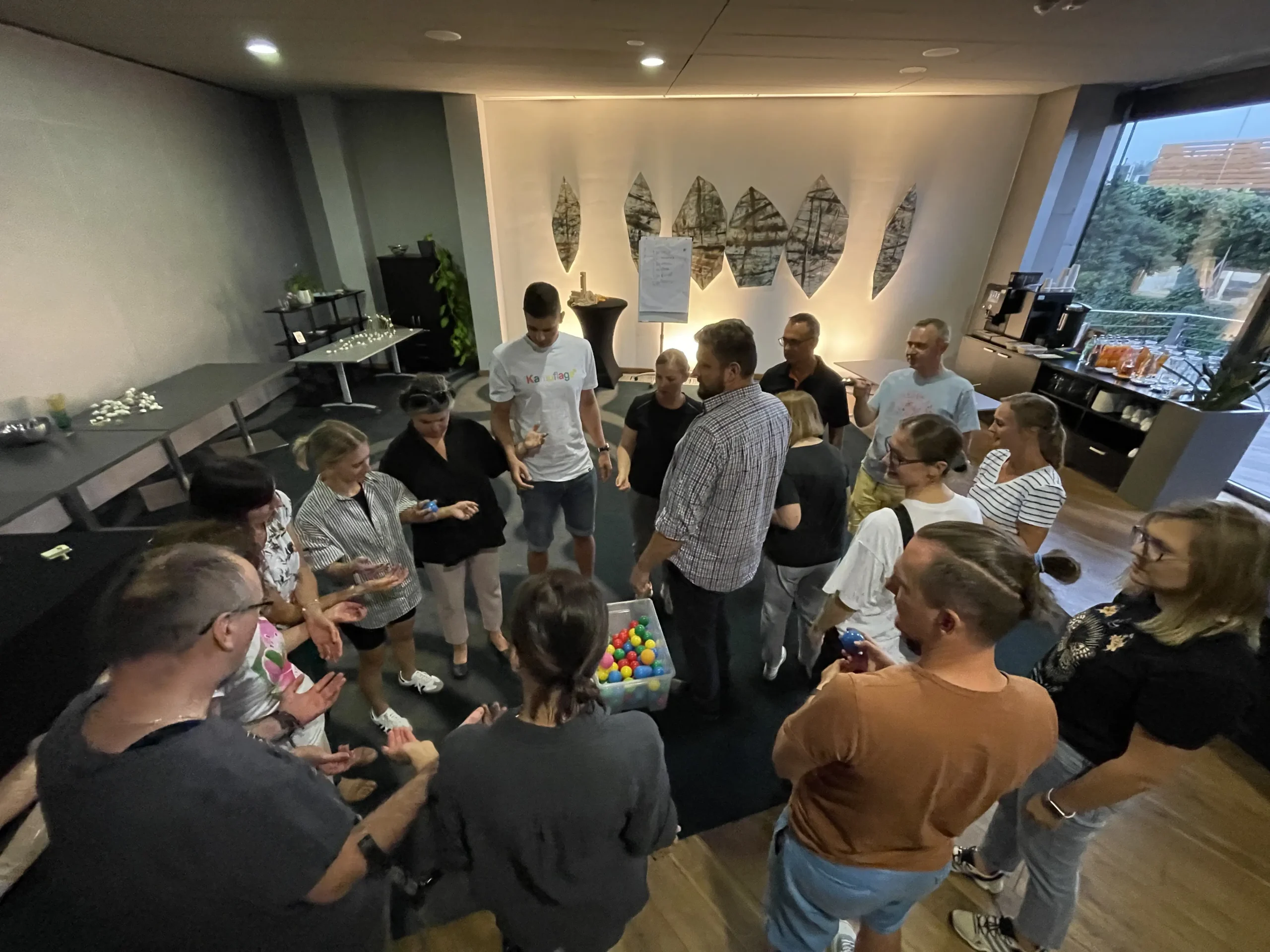
The Transporters game can be played in several ways, but here’s the version we use most often:
Preparation:
Prepare two large boxes and at least 100 lightweight plastic balls (ping pong balls also work).
Place all the balls in one box, leaving the second box empty. At this point, the boxes can be placed anywhere.
Appoint one referee (e.g., the game leader) to oversee the proper execution of the task.
A minimum of 5 participants is needed for the challenge.
Rules:
The team’s goal is to transfer as many balls as possible from the full box to the empty one within 60 seconds. Simple enough, but here come the constraints:
One designated participant must be the first to touch each ball removed from the full box and also the last to touch each ball placed in the empty box.
Any ball not initially removed or finally placed by this participant will not count toward the final score.
Each ball must be touched by every hand of all participants in the game. For example, if a player has two hands, both must touch every ball.
Important twist: No participant can touch the ball with both hands simultaneously or consecutively. A ball cannot be immediately passed from one hand to the other by the same participant. Before a participant’s second hand touches a ball, at least one hand from another participant must touch it. How this is done depends on the team’s strategy
Any ball that fails to meet at least one of these rules will not be counted in the final score.
After 60 seconds, tally the results. The team then has 5 minutes to discuss and potentially adjust their strategy before attempting another round.
Typically, the team is allowed three attempts, and the best attempt is recorded as the final score.
The game can be modified by slightly changing the rules or adding challenges to how the balls are passed. Alternatively, the entire game can be played using water transfer, where water is moved from one bucket to another using cups. Additionally, the cups can vary in size to add more complexity.
This game helps develop all three skills mentioned in this article: problem-solving, creativity, and collaboration. It’s an excellent team-building activity for children, teenagers, and adults alike
CONNECTED – SIMPLE TEAM-BUILDING CHALLENGES
Preparation:
Line up the participants in a single row.
Place a sheet of paper or a tennis ball between the shoulders of each pair of adjacent participants.
Rules:
The team’s goal is to complete a specified task together without letting the paper or ball fall to the ground.
Start with basic and simple tasks such as stepping forward, stepping backward, or squatting.
Create a list of levels that the team can complete together. For example, the first level could be stepping forward, while the sixth level might involve forming a circle together.
To make the challenges even more interesting, you can add communication restrictions. For instance:
Participants can only use single words instead of full sentences.
They can only make sounds without forming proper words.
They can only communicate by singing.
This activity sharpens teamwork skills while also guaranteeing lots of laughs
RUNAWAY BAG – A THROWING TEAM-BUILDING GAME
Let’s continue with some movement-based games, perfect for PE classes
Preparation:
Prepare a rope attached to a sled or another platform with low friction against the ground. The rope should be at least 10 meters long.
Place a basket or bucket on the platform and ensure it won’t tip over when hit by thrown balls. You can add a weight inside for extra stability.
Use cones to mark two parallel lines approximately 4–6 meters apart.
Gather plenty of soft balls, tennis balls, or ping pong balls, adjusting the type of balls to what you have and the size of the basket or bucket.
Choose one person (this can be the leader) to pull the rope and move the basket back and forth between the two lines.
The remaining participants with balls stand along both sides of the marked lines.
Rules:
At the signal, the leader starts pulling the rope, slowly moving the basket along the path between the two lines.
Participants standing behind the lines throw balls in an attempt to land them in the moving basket.
Throws can only be made from behind the designated lines.
Participants can move around to collect balls, but once a ball is in hand, it must be passed to someone standing at one of the lines.
Balls that land in the basket but fall out again do not count toward the final score.
The challenge ends once the basket crosses the finish line. At that point, count how many balls remained in the basket.
In this game, the score matters, but so does effective task distribution: who collects the balls, who throws them, how the team positions themselves, and how they communicate while passing the balls, etc.
This variation of the game can definitely be modified further, with additional challenges and new rules to make it even more engaging.
Tik Tok – A LARGE TEAM-BUILDING GAME
Here’s a slightly more complex game that requires some preparation and a basic understanding of the group. It works perfectly for larger groups, ideally with at least 15 participants. What’s great about this game is that it can be adapted to almost any age group.
Preparation:
Create a list of tasks and assign points to each one. Depending on the goal of the game and the age group, the tasks can vary in nature. For example:
Physical (e.g., perform 100 jumping jacks, create a pyramid with 4 people that holds for at least 20 seconds)
Creative (e.g., write a poem, come up with 20 rhyming sentences on a specific topic)
Teamwork (e.g., cooperate to solve a task together).
Set a time limit for the challenge, for example, 10 minutes.
Rules:
The group receives a copy of the task list. They have 2 minutes to review it and choose which tasks they want to complete.
The group then has 10 minutes to complete ALL of the selected tasks.
If the group fails to complete all chosen tasks, they receive 0 points.
During the challenge, the group cannot change the tasks they selected.
After one round, you can repeat the challenge with the same or different tasks for comparison.
Link to full rules
In this team-building game, a good plan of action and solid cooperation are key. Along the way, we can learn more about each other’s strengths and weaknesses. It’s also important to be realistic about what can be achieved — after all, if we don’t complete at least one of the selected tasks, we haven’t completed the entire mission!
CONSTRUCTION RECONSTRUCTION – IMAGINATION AND SMART COMMUNICATION
Preparation:
Gather a variety of items: cups, ropes, sticks, mattresses, branches, corks, bottle caps, blocks, or anything else you have available.
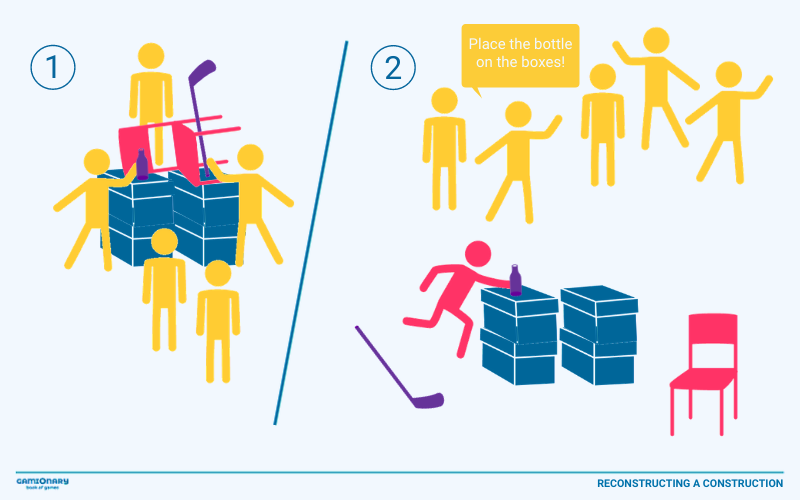
Select one-third of the group to leave the room.
Rules:
The remaining participants in the room use the available items to create the largest, most majestic structure they can build.
Once the structure is complete, they take a few pictures of it and then tear it down.
The players who were out of the room return.
Set a time limit, for example, 5 minutes.
The participants who built the structure must now instruct the others to recreate the structure using the photos as a guide.
Link to full rules
The game is a bit tricky because participants can intentionally create a simple structure. To make it more challenging, it’s a good idea to add some restrictions, such as requiring the use of all the items or ensuring that the structure resembles a well-known object or building. For the first round of the game with a new group, you can even avoid telling them the goal of the activity to add a little extra intrigue .
In summary: Team-building games without winners bring many benefits. They develop collaboration, problem-solving, and creativity skills, especially in children. The joy of achieving a common goal or improving a result is evident in all participants. Any team-building games, and not just those without winners, are excellent for developing executive functions, including cognitive flexibility, inhibitory control, and working memory. These skills help maintain attention, filter out distracting details, improve self-regulation and self-control, enhance problem-solving abilities, and foster mental flexibility.
There are, of course, many more team-building games without winners, and you can create countless variations. It’s worth drawing inspiration from the games and activities in our eBooks and from the game browser at gamionary.com.
Table of contents
The Power of Games and Physical Activities
The book "The Power of Games and Physical Activities" shows how to use games and activities for student development – not just physical, but also emotional, social and cognitive. It is a practical and inspiring guide for PE teachers, coaches and facilitators, full of scientific research, examples and ready-made ideas.
To provide the best experiences, we use technologies like cookies to store and/or access device information. Consenting to these technologies will allow us to process data such as browsing behavior or unique IDs on this site. Not consenting or withdrawing consent, may adversely affect certain features and functions.
Functional
Always active
The technical storage or access is strictly necessary for the legitimate purpose of enabling the use of a specific service explicitly requested by the subscriber or user, or for the sole purpose of carrying out the transmission of a communication over an electronic communications network.
Preferences
The technical storage or access is necessary for the legitimate purpose of storing preferences that are not requested by the subscriber or user.
Statistics
The technical storage or access that is used exclusively for statistical purposes.The technical storage or access that is used exclusively for anonymous statistical purposes. Without a subpoena, voluntary compliance on the part of your Internet Service Provider, or additional records from a third party, information stored or retrieved for this purpose alone cannot usually be used to identify you.
Marketing
The technical storage or access is required to create user profiles to send advertising, or to track the user on a website or across several websites for similar marketing purposes.





 The Transporters game can be played in several ways, but here’s the version we use most often:
Preparation:
The Transporters game can be played in several ways, but here’s the version we use most often:
Preparation:
 Preparation: