Nowadays, people spend most of their time locked in four walls. Children playing outside have become a rare sight. However, less time spent outdoors means lower activity, resilience and psycho-physical development.
Important! The list below is just our subjective choice – it contains simple games for name memorization, group drawing and physical activities.
Our data base has over 1300 different games with available modifications. You can sort them, among others, by: number of children, age, available equipment and place, skills to develop. We guarantee that you will find a game that will meet your expectations. You will find all you need
in our Book of Games
A list of the most interesting outdoor games for children:
Games without equipment
Outdoor games with a ball
Why is it so important for children to play outside?
Scientists have clearly proven that spending time outdoor has a beneficial effect on our brain. It lowers our stress level and, at the same time, increases our feeling of happiness. It is easier for us to zen out and relax. It has also a positive impact on cognitive abilities such as concentration and memory. It is also obvious that games are a perfect
team-building opportunity for children.
What is more, outdoor activity has a favorable influence on the child’s fitness and health. His or her immune system is being stimulated. As a result, the child will be more resistant to diseases and catching a cold. Additionally, staying outside on a sunny day will increase production of vitamin D – another healthy aspect.
Outdoor
physical games for children also play an important role in the child’s psychomotor development. When outside, the child experiences completely different sensations, which helps in his or her proper development. It is especially advantageous to spend time in parks and forests. Moreover, outdoor physical games often involve a group of peers, which facilitates socialization.
Ideas for outdoor games for 10-year-olds – how to encourage children to be active?
When looking for outdoor activities for 10-year-olds and older children, you must remember that children at that age are very proficient in using a computer, a smart phone or a gaming console. It is a very important aspect because the design of modern games forces maximum involvement or even addiction. That is why a simple walk in the park will not be stimulating enough for the youngsters.
You should look for games and activities that offer an interesting form and allow stimulating various areas of functionality. In this case, the best choice will be games that encourage cooperation and develop skills such as dexterity, concentration or speed. When deciding on outdoor physical games, try to keep everything diverse. You should not limit yourself to basics such as tag or hide and seek.
Our book of games and activities will come in handy and help you choose outdoor games for older children, because each of them specifies the areas of functioning they stimulate. It will help you select diversified games that will meet children’s needs.
You also need to bear in mind that encouraging children to take part in more intense physical activity will take time. You cannot expect that a child who has spent most of their time at home will suddenly eagerly stay outside for most of the day. The transition must be gradual. That is why you must pay attention to children’s outdoor activity at young age – they will simply develop a habit and keep doing it when they grow older.
You must also remember that children follow their parents’ example. If you spend most of the time at the computer or with a smart phone in your hand, the child will perceive such form of spending one’s free time as something natural. If you want your children to play outside more often, you must start doing it yourself.
1.Sardines
 Preparation
Game rules
Preparation
Game rules
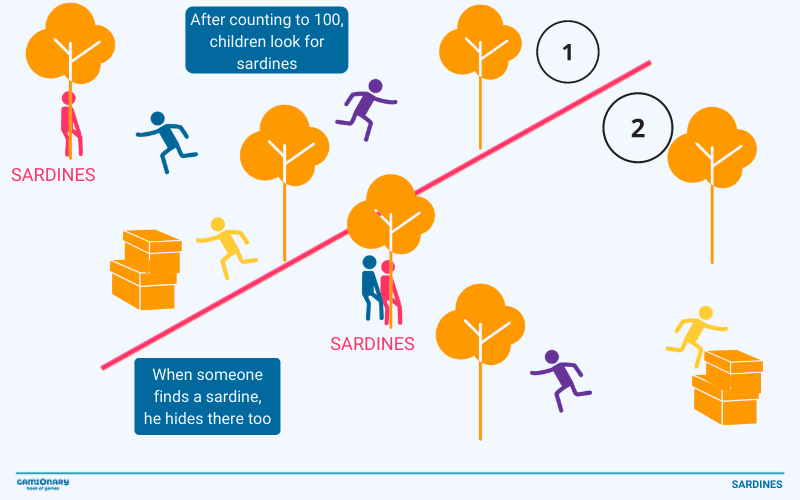
- Choose one player to be a sardine and tell him/her to hide. Meanwhile, other players count to 100.
- Once they counted to 100, players split and each of them tries to find the sardine.
- When they find the sardine, they quietly hide with the sardine at the same spot.
- The last person to find the sardines becomes the first sardine in the next game.
Goal
You will find the full description + variations here: Game “Sardines”
- What time is it, Mr. Fox?
 Preparation
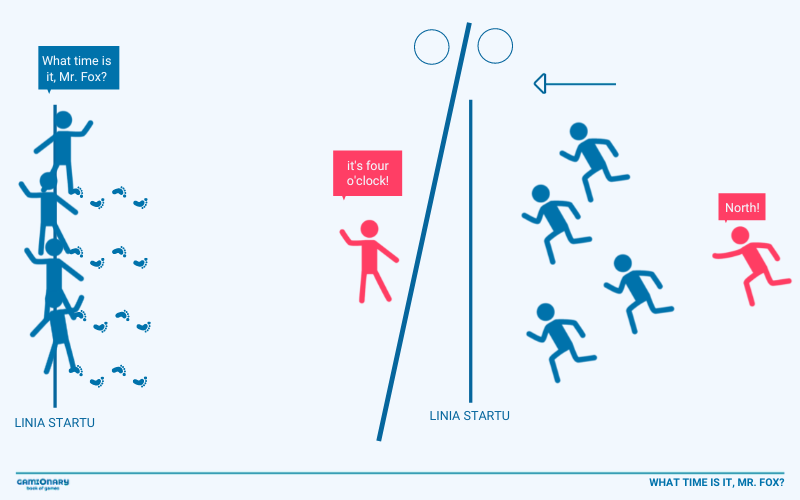
- Choose a person who will be Mr. Fox.
- Select the start line, 20-30 steps away from Mr. Fox, and ask the rest of the players to stand there.
Game rules
- Players shout: “What time is it, Mr. Fox?” and Mr. Fox replies: “it’s (e.g.) four o’clock!” (he/she can only tell full hours).
- The said time determines the number of steps -players can move towards Mr. Fox (in this example, it will be four steps).
- When Mr. Fox says: “midnight!” – all players turn around and run to the start line while Mr. Fox tries to catch them.
- When someone is caught, he/she becomes the new Mr. Fox.
Goal
- To catch other players/run from Mr. Fox.
You will find the full description + variations here: Game “What time is it, Mr. Fox?”
- Dangerous beach
 Preparation
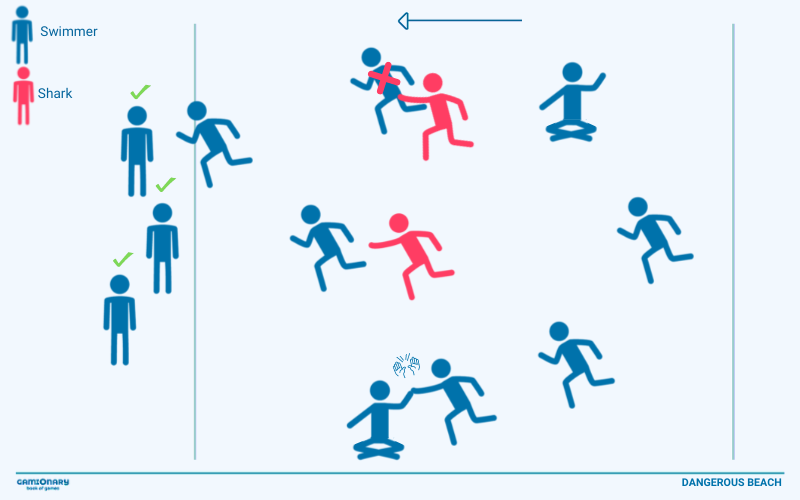
- Designate 2 lines on both sides of the game area.
- Choose several people who will be the sharks and ask them to stand in the middle of the game area. Other players will be the swimmers.
Game rules
- When sharks shout “SHARK ATTACK”, the swimmers start running to the other side of the room but must avoid being caught by a shark. Swimmers will be safe only behind the marked lines.
- Sharks, on the other hand, must catch as many swimmers as possible.
- When a swimmer is caught by a shark, he/she must sit down on the ground and start waving their hands to get help.
- It will be possible to rescue the swimmer in the next round. To do it, another swimmer must “swim” near the caught swimmer and do a “high five”; the caught player is rescued and can join the game in the next round.
Goal
- To get to the other side of the room/catch swimmers.
You will find the full description + variations here: Game “Dangerous Beach”
- Spy
 Preparation
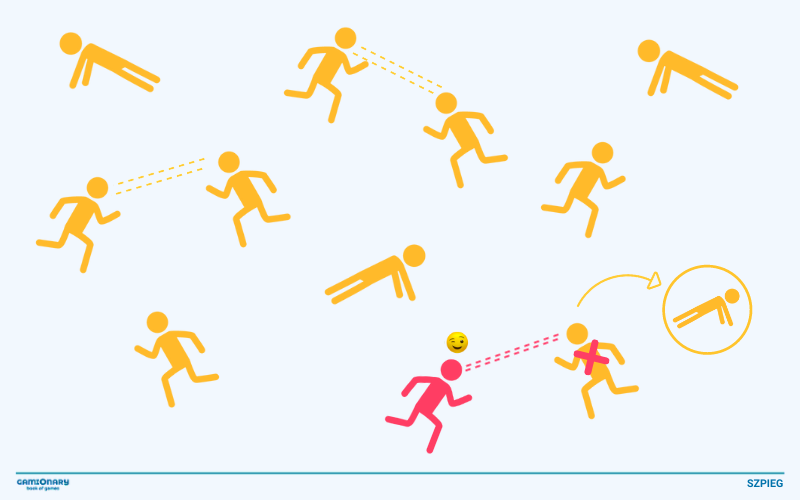
- Designate the area for the game.
- Choose one person from the group who will be the spy.
Game rules
- Players move around the game area and make eye contact with each other.
- The spy must secretly eliminate player by winking at them. When the spy winks at somebody, that person becomes poisoned.
- The poisoned player must quietly fall on the ground and remain in the “plank” position.
- When the spy winks at someone and another person sees that, he or she can report it by raising their hand and shouting “I FOUND THE SPY!”. If the person is wrong – he or she is off the game; if he or she is right – the round ends.
- The game ends when the spy manages to eliminate all the players or when someone finds the spy.
Goal
- To blow the spy’s cover/eliminate all the players.
- City Gates
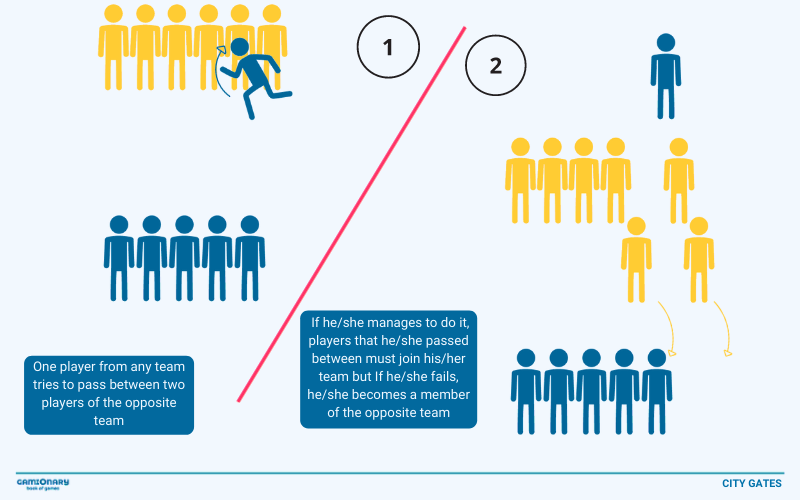 Preparation
- Divide participants into teams.
- Teams stand in rows facing each other.
- Players in teams hold hands.
Game rules
- One member of the team starts to force themselves to the other side, trying to pass between two players of the opposite team.
- If he/she manages to do it, players that he/she passed between must join his/her team.
- If he/she fails, he/she becomes a member of the opposite team.
- The teams take turns until there is only one person left in one of the teams.
Goal
You will find the full description + variations here: Game “City Gates”
- Treasure Chest
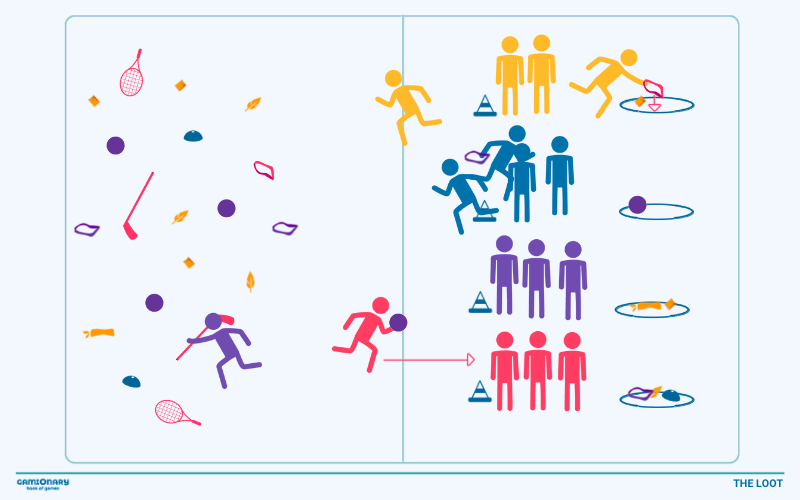 Preparation
- Divide players into teams.
- Place various items (e.g. balls, sashes, sacks) on one side of the gym.
- On the other side, place a line of cones and ask the teams to stand behind them.
- Place a hula hoop behind each team.
Game rules
- On signal, the first player from each team runs to take the treasure, gets back and places it inside the hula hoop.
- When the first player is on their way back and crosses the line of cones, the next person from the team can start their turn, etc.
- The game ends after a time limit set by the game leader.
- The team that manages to collect the “secret treasure” wins. The losing team must perform a task given by the game leader (e.g. 10 jumping jacks).
Goal
- To collect the secret treasure.
You will find the full description + variations here: Game “Treasure Chest”
- 500
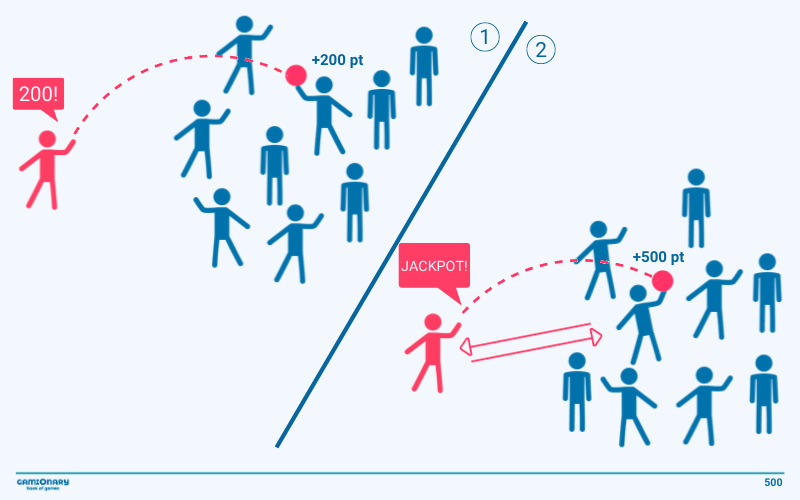 Preparation
- Choose one person to be the thrower and give them a ball.
- Other players should scatter in front of the thrower.
Game rules
- The thrower throws the ball and, at the same time, calls out any number of points (e.g. 150).
- The player who catches the ball receives the called-out amount of points (+150).
- When the player catches the ball but then it falls from his or her hands – the called-out amount of points is deducted from his/her score (-150).
- When the thrower shouts “JACKPOT” when throwing the ball, the person who will manage to catch it will receive 500 points.
- When somebody collects 500 points or more, he/she becomes the new thrower.
- The ball may bounce off the ground any number of times.
Goal
You will find the full description + variations here: Game “500”
- Catch!
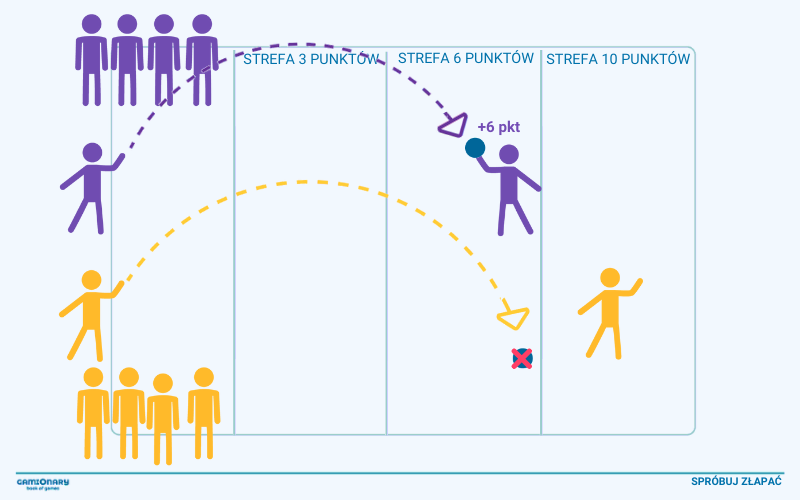 Preparation
- Divide the field into various scoring zones.
- Divide participants into 2 teams.
- Choose one person from each team who will be the first thrower and one person who will be the catcher. The thrower stands at the side of the field while the catcher – within the scoring zones.
- Others must stand in lines at the sides of the field.
- Give each team a ball or a Frisbee.
Game rules
- Throwers from both teams throw the ball to the scoring area.
- The catcher must catch the ball and throw it back to their team.
- When the catcher catches the ball, the team scores points. The number of assigned points depends on the zone in which the ball was caught.
- Next, players change their roles: the thrower becomes the catcher, the catcher goes to the end of the line while the first person from the line becomes the thrower.
- The team that scores more points within a set time limit or is the first to score a specific number of points wins.
Goal
- To score as many points as possible.
You will find the full description + variations here: Game “Catch”
- Special Operation
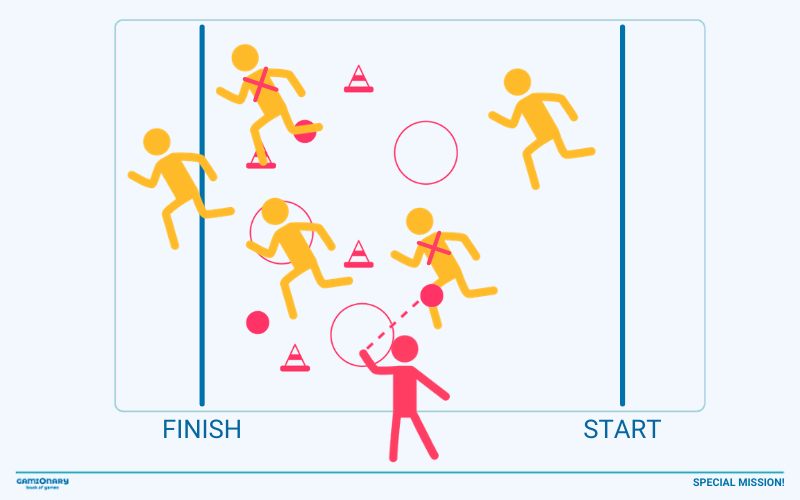 Preparation
- Participants stand in a row on one half of the game area. There are cones and hula hoops placed on the other half.
- The game leader stands at the side line with balls.
Game rules
- On signal (given with a whistle), the participant runs to the other half, avoids obstacles and balls that are thrown at him/her by the game leader.
- The participant must reach the end line without being hit or without bumping into any of the obstacles.
Goal
- To correctly complete the task as quickly as possible.
You will find the full description + variations here: Game “Special Operation”
- Who’s faster?
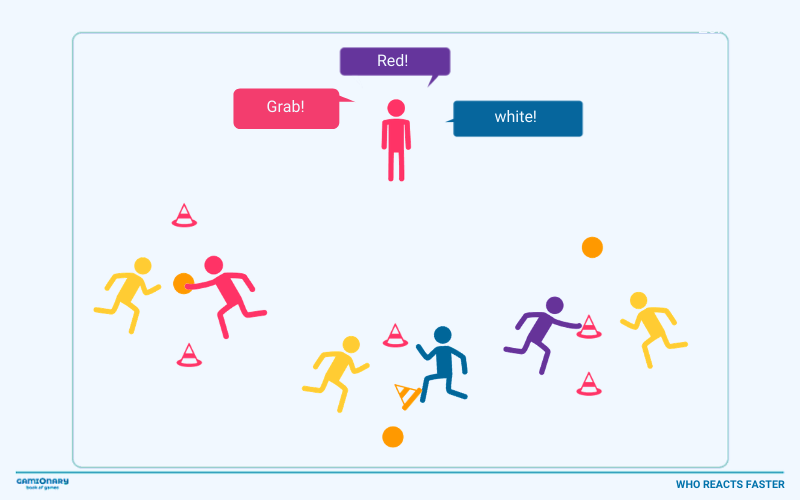 Preparation
- Ask participants to stand in pairs, facing each other.
- Put 3 or more items e.g., a cone, a ball, another cone, between the players.
Game rules
- The game leader gives commands: “Grab!” – players try to take the ball, “Red!” – they knock down the cone, “White” – they touch the cone.
Goal
- To complete the task faster than the partner.
You will find the full description + variations here: Game “Who’s faster”
These are only examples of the team-building games we recommend for children. You will find more team-building games with our
browser and on our
YouTube channel. There, you can choose anything you are interested in: the place of the game, the number of children in the group, their age or the equipment that you have at your disposal. As a result, you will find the perfect number of games depending on whether you work at kindergarten, school or in a soccer club.
Our browser is a perfect tool for every teacher who is interested in playing with any group of children. As you can see, we have prepared games that are slightly different from the standard formula such as “Children and names” or “Children sitting in a circle or standing in a circle”, or the classic “Children swap places”. Of course, you can use those games. Everything depends on your group.